decode sample data

Asterismby null-sec

Asterism Manages Scattered Threat Intelligence in One System You Can Explore.

Vendors, CERTs and researchers publish every day, and many reports describe something you've already read under another name. Asterism reads them, pulls out the actors, malware, infrastructure and techniques, and links everything into one graph you can pivot through. It supports API, MCP, and an AI co-pilot to present information logically.

Request accessFollow one intrusion

Hosted by Null Sec at asterism.exchange, by invitation.

Illustration: a star chart above a few rows of noise.bin, a small sample file. A read head sweeps the rows and every null byte lights up. Three nulls, the ends of an actor name, an address and a domain from one sample report, lift out of the file and become the three stars of the Asterism mark, with the actor CRANE-41 as the lavender top star. A few more nulls become the stars around them. A line drops from the top star to the left margin, where it runs down the page. The file is harmless sample data.

One Intrusion, Followed to an Answer You Can Cite

Scroll down to watch four figures follow one sample intrusion through Asterism. CRANE-41, Hold Music and every report below are invented for this page, and the addresses and domains sit in ranges reserved for documentation.

  1. Fig. 1 · Noise

    Four Names for One Week of Intrusions

    A CERT bulletin, two vendor write-ups, a researcher's thread and an ISAC digest describe the same week of help-desk intrusions. They call the intruder four different things, and one address, 198.51.100[.]23, turns up in four of them.

    Read one at a time, they look like four separate stories.

    tail -f · 5 sourcessample data
    • 21 Oct 09:12cert.exampleadvisoryActivity cluster 2026-114: help-desk resetscluster 2026-114198.51.100[.]23T1566.004
    • 21 Oct 14:12vendor-a.examplerssCRANE-41 calls the help deskCRANE-41198.51.100[.]23helpdesk-sso.example[.]netT1656
    • 22 Oct 05:12vendor-b.examplepdfHold Music returns with new infrastructureHold Music198.51.100[.]23helpdesk-sso.example[.]netT1656T1556.006
    • 22 Oct 20:12researcher.examplethreadSame infra, new domains"the help-desk crew"198.51.100[.]23sso-verify.example[.]com
    • 24 Oct 09:12isac.examplemailDaily digest, one TLP:CLEAR itemhelpdesk-sso.example[.]netsso-verify.example[.]comT1556.006

    4 names for one intruder1 address in 4 reports1 domain in 3

    Fig. 1Five sample reports as they arrive, newest last.Plate II
  2. Fig. 2 · Extraction

    Pull Out Everything You Could Pivot On

    Each report is read for indicators, threat actors and their aliases, malware, tools, CVEs and ATT&CK techniques. Indicators are refanged for matching and shown defanged.

    A name nobody has used before stays a candidate, out of every count and export, until a second organization reports it or an analyst approves it. One blog post can't invent an actor.

    report 2 of 5 · vendor-a.example · rssexcerpt written for this page

    paragraph 3The intruders, a cluster we track as CRANE-41, phoned the service desk while posing as a contractor and talked an agent into resetting a password. Within the hour the account signed in from 198.51.100[.]23, and the next morning helpdesk-sso.example[.]net went live.

    • actorCRANE-41candidate · 1 organization so far, held out of counts
    • ipv4198.51.100[.]23also in 3 other reports
    • domainhelpdesk-sso.example[.]netalso in 2 other reports
    • techniqueT1656Impersonation · also in 1 other report
    Fig. 2One paragraph, four entities, each typed and linked back to the sentence it came from.Plate III
  3. Fig. 3 · Correlation

    Link the Reports That Share Evidence

    Shared infrastructure and techniques pull the five reports into one Story. Gravity then tests each pairing of entities against chance and ranks it by a conservative lower bound, and an organization that repeats itself counts as one witness.

    A pairing seen by one organization is never counted as evidence; where the graph shows it, it's dashed. CRANE-41 stays a hollow candidate until a second organization names it.

    story · 5 reports · 5 organizationsgravity · npmi, 95% lower bound · reports, 30 days
    R1 · cert.exampleadvisory · 21 OctR2 · vendor-arss · +5 hR3 · vendor-bpdf · +20 hR4 · researcherthread · +35 hR5 · isacmail · +3 d0.47 · 2 org0.23 · 2 org0.33 · 2 org0.22 · 1 org0.25 · 1 orgipv4 · 4 reportsT1656techniquehelpdesk-sso.example[.]netdomain · 3 reportsT1556.006techniquesso-verify.example[.]comcandidate · held outCRANE-41198.51.100[.]23
    Fig. 3Grey lines are mentions. Teal lines are Gravity scores at their 95% lower bound, with the number of independent organizations behind each. Dashed pairs have one organization and are never counted as evidence.Plate IV
  4. Fig. 4 · Answer

    Ask the Question You Came With

    Ask in AQL, the Asterism Query Language, or click any entity and every view refocuses on it. Defanged indicators work as typed.

    Here the question is who saw this intrusion first and what each later report added. The Story answers it, and the four names stay side by side for an analyst to judge.

    explore · last 14 dayssample data

    ip:198.51.100[.]23 published:>now-14d

    4 reports, all in 1 Story of 5 reports from 5 organizations · names in use: cluster 2026-114, CRANE-41, Hold Music, the help-desk crew, all held as candidates

    • certfirst · address, T1566.004 (cluster 2026-114)
    • vendor-a+5 h · domain, T1656 (CRANE-41)
    • vendor-b+20 h · T1556.006 (Hold Music)
    • researcher+35 h · sso-verify domain (the help-desk crew)
    • isac+3 d · nothing new
    Fig. 4The Story view's lanes, redrawn: who reported first, each source's lag, and what it added.Plate V
One Indicator, and Every Report Behind It

Every entity keeps its own record: who reported it and when, how fresh it is, whether it turns up on benign lists, and what it keeps company with. This is the entry an analyst opens from the Story above.

NSC bfeb4cPlate VI0.47 · 2 orghelpdesk-sso.example[.]net0.23 · 2 orgT16560.22 · 1 orgsso-verify.example[.]com0.04 · 1 orgT1556.006198.51.100[.]23origin 0x002,214 reports · 30 days

NSC bfeb4cipv4-addrTLP:CLEAR

198.51.100[.]23

AS64500 · catalog number = first 6 hex digits of sha256("198.51.100.23")

Reports
4, from 4 organizations
First
21 Oct 2026, cert.example5 hours ahead of the next report
Last
22 Oct 2026, researcher.example
Fresh
0.7612 days since the last report, half-life 30 days
Benign
No benign-list match
Story
Help-desk resets, 21 to 24 Oct5 reports, 5 organizations

Gravity · lower bound · orgs

Dashed rows rest on one organization: shown for context, never counted as evidence.

Reports per day · 21 Oct to 3 Nov

2 on 21 October, 2 on 22 October, none on the other days.

Export: STIX 2.1 · MISP · CSVOpen in Constellation

Fig. 5Catalog entry for NSC bfeb4c. Sample data: 198.51.100.0/24 and AS64500 are reserved for documentation. Gravity here counts reports over 30 days.Plate VI

Instruments That Explain Their Numbers

Every statistic Asterism shows links to the method behind it, and to a list of what that method does not claim. All six instruments below ship in the current release; planned work stays off this page until it ships.

  • instr. 0x01trending

    Supernova

    Burst detection with false-discovery control. An entity reaches the board only when its share of coverage rises clearly above its own baseline, after correcting for how many entities were tested, in at least three stories from at least two organizations.

    How Supernova decides
  • instr. 0x02association

    Gravity

    What appears alongside an entity more often than chance allows, scored by NPMI, lift and Fisher's exact test and ranked by a conservative lower bound. A pair needs two independent organizations before it counts.

  • instr. 0x03names

    Rosetta

    One row per actor, with each vendor's name for it credited to that vendor. A name recorded for two different actors is flagged as ambiguous for you to judge, and never merged.

  • instr. 0x04query

    AQL

    AQL, the Asterism Query Language: field filters with pipes such as top, timechart, cooccur and trending, with autocomplete and a visual builder that stays in sync.

    The AQL reference
  • instr. 0x05clustering

    Stories

    Every report of one activity in one place, with the first publisher marked and each later report's lag and additions beside it. Ten outlets rewriting one post count as one observation.

  • instr. 0x06collection

    Asterism Capture

    A browser extension for Firefox and Chromium. When a page can't be fetched openly, an analyst reads it in their own browser and sends what the browser shows. Pairing takes a few clicks, and the extension's key can only submit captures.

  • Additional Features

    • Investigations: saved, replayable pivot trails with notes
    • Watchlists and alerts on saved queries
    • ATT&CK heatmap, known against observed per actor, Navigator export
    • Vulnerability radar with KEV, EPSS and CVSS
    • Indicator freshness and a benign-context layer for noisy indicators
    • Source scorecards and corroboration
    • REST API with scoped keys, a TAXII 2.1 server and a read-only MCP server
    • Exports to STIX 2.1, MISP, CSV, GEXF and Navigator layers
    • Roles, MFA and an audit log
    • Six themes that meet WCAG AA

Explore Asterism - Overview

Search, explore, and filter on the threats you care about. When you first create an account, you have the ability to create custom views or "point the telescope" based on region, industry, or threat actor. This helps shift Asterism to provide custom views and layouts for the data you care most about.

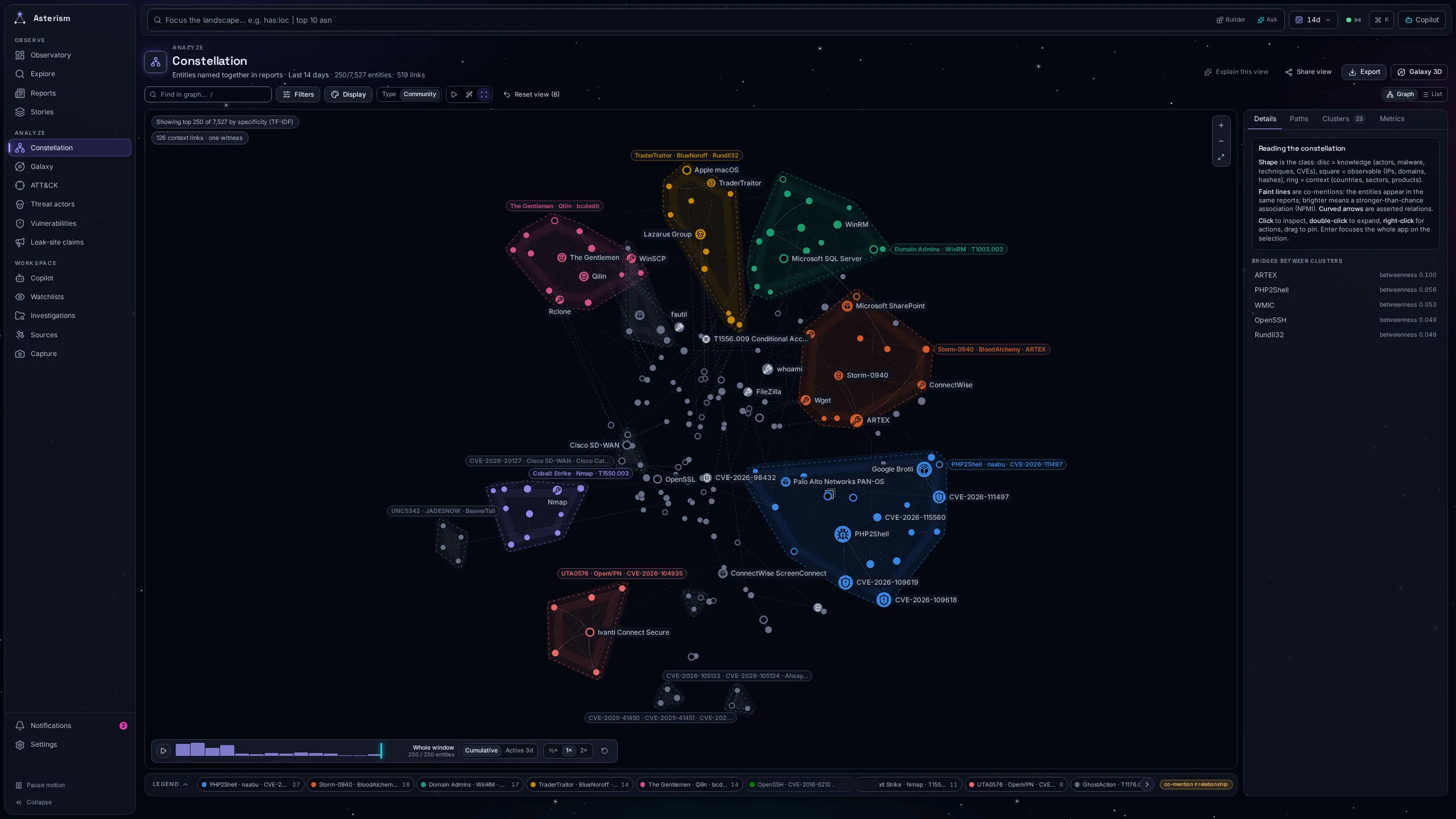
Asterism's Constellation view: the entities named together in the last 14 days of reports, drawn as a graph with each cluster colored, outlined and labeled, and the bridges between clusters listed beside it.
full size
Fig. 6Constellation. Click any node and the dashboard, ATT&CK matrix and reading list follow it.Plate VIII
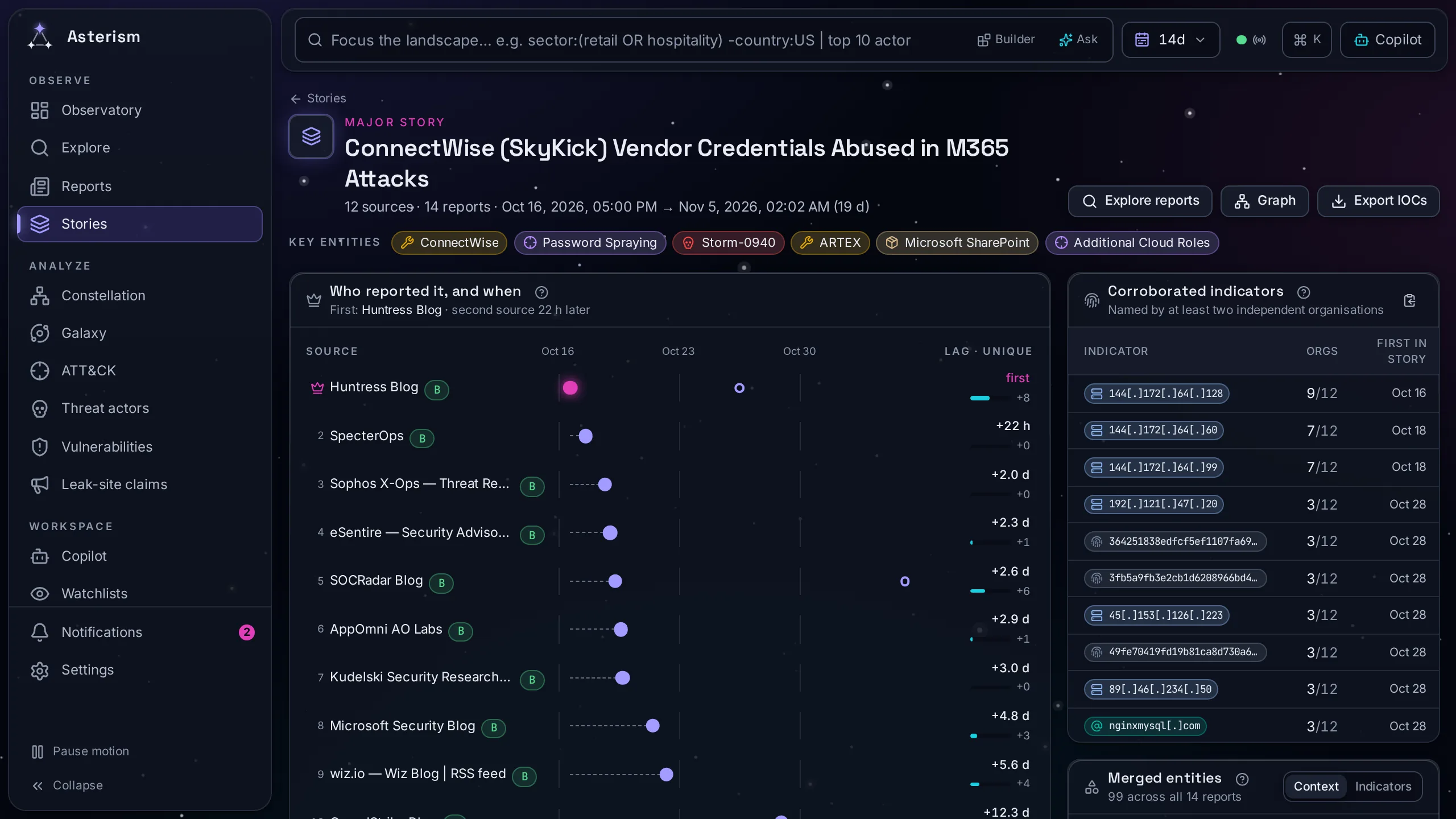
Asterism's Story detail view for one event, vendor credentials abused in Microsoft 365 attacks, reported by 12 sources: a timeline of who reported it first and how far behind each later report came.
full size
Fig. 7Story detail, the app's own version of the lanes above.Plate VIII
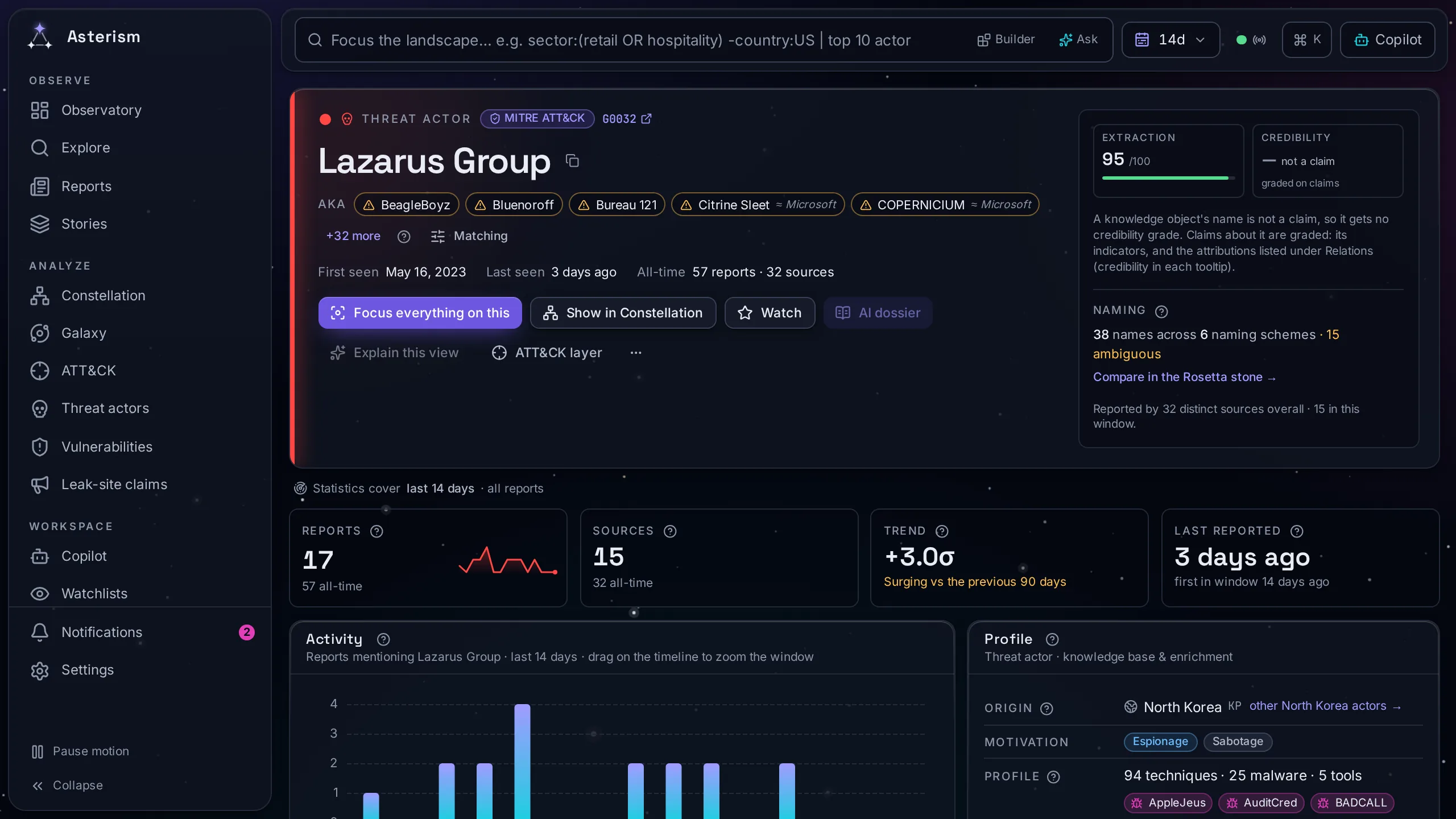
Asterism's Entity lens on Lazarus Group: its aliases with the vendor that uses each, report and source counts with their trend, and its activity over the last 14 days.
full size
Fig. 8Entity lens, the full version of the catalog entry above.Plate VIII
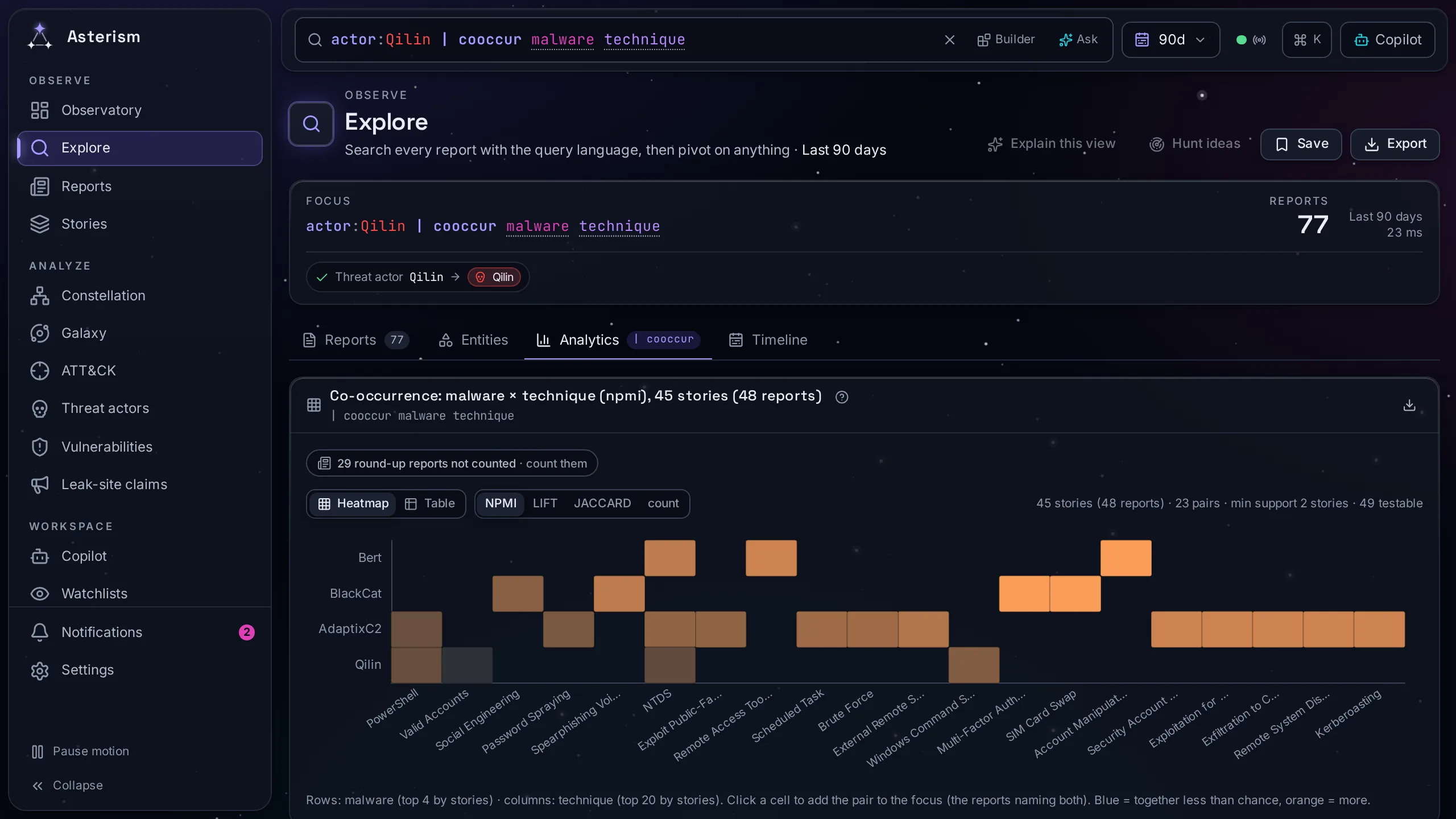
Asterism's Explore view running the AQL query actor:Qilin | cooccur malware technique over 90 days: a heatmap of the malware and ATT&CK techniques named together in the same stories more often than chance.
full size
Fig. 9Explore, where AQL runs.Plate VIII

Every Input Keeps Its TLP Audience

By default, all ingested intel is either TLP:CLEAR or TLP:GREEN. Higher TLP requires elevated account access, which comes with information sharing controls.

asterism sources · by type14 types

asterism sources ls -l

namewhat it ismodeownertlpformat
feedVendor research blogs and CERT advisories-r--r--r--asterismclearrss, atom
webWrite-ups fetched openly by AsterismBot-r--r--r--asterismclearhtml
pdfWhitepapers and long-form reports-r--r--r--asterismclearpdf
taxiiTAXII 2.1 collections-r--r--r--asterismclearstix 2.1
mispMISP feeds-r--r--r--asterismclearmisp json
iocIndicator lists-r--r--r--asterismclearcsv, txt
capturePages sent from your browser by Asterism Capture-rw-------youprivatehtml
uploadDocuments you add, at the TLP you set; share them through an access group-rw-------youprivatepdf, html
attackMITRE ATT&CK®-r--r--r--asterismkbstix 2.1
misp-galaxyActor, tool and sector clusters-r--r--r--asterismkbjson
kevCISA Known Exploited Vulnerabilities-r--r--r--asterismkbjson
epssFIRST EPSS exploit prediction scores-r--r--r--asterismkbcsv
ip2asnIP to ASN mapping-r--r--r--asterismkbtsv
gleifLegal entity identifiers-r--r--r--asterismkbjson
Fig. 10Source types as Asterism lists them. The tlp column is the audience: clear for anyone, private for you alone, kb for public reference data.Plate IX

300+curated public sources to start, as of Nov 2026

Vendor research, CERT advisories and independent researchers, read through a fetch chain that announces itself. AsterismBot, the crawler, names itself in its user agent, and its own page says what it reads and how robots.txt steers it.

Licensed feeds are not included. You can upload documents, send pages with Asterism Capture, and suggest a public source for us to review.

Each Number Comes With Its Limits

Each method has limits, and Asterism prints them next to the numbers they qualify. These four matter most before you trust a chart.

  1. 0x01

    Coverage is not activity. A spike in reports means more people wrote about something. Supernova tells you a rise is unlikely to be chance; it can't tell you attacks went up.

  2. 0x02

    Co-mention is not a relationship. Gravity measures how often two entities appear together compared with chance, names the statistic it used and shows how many organizations stand behind each pair.

  3. 0x03

    Extraction makes mistakes. We measure the extractor on reports it never trained on, and those figures aren't published yet.

  4. 0x04

    Aliases are never merged silently. Each alias carries the vendor that uses it, and a name two actors share is flagged as ambiguous for you to judge.

Supernova board · 7 days to 3 Nov 2026sample data, not live

  • risingT1656 Impersonation9 stories against 1.82 expected · q 0.034 · 5 organizations
  • not listedT1566.004 Spearphishing Voice6 against 1.24 expected · q 0.18, above 0.05
  • not listedT1556.006 Multi-Factor Authentication5 against 1.08 expected · q 0.29, above 0.05
  • not listedT1621 MFA Request Generation4 against 0.83 expected · one organization
  • untestableT1219 Remote Access Tools3 stories in total, too few to reach significance
  • untestableT1110.003 Password Spraying2 stories in total, too few to reach significance
  • not listedhelpdesk-sso.example[.]net1 story, 3 organizations · a riser needs 3 stories
  • cannot tell24 h windowsources carrying most of the window stalled, so no comparison is made

Getting an Account

Accounts open by invitation, one request at a time.

available now

Hosted by Null Sec

Where
asterism.exchange, operated by Null Sec
Access
By invitation, on request
Sign-in
Passwords, with MFA available
Cost
Nothing is on sale yet

Questions a Security Team Asks First

Short answers, without infrastructure details.

Is it hosted, or can we run it ourselves?

Null Sec runs the only instance, at asterism.exchange, on AWS in the US, and there's no self-hosted version.

What happens to our uploads and their TLP?

The terms of use and the acceptable-use rules cover uploads, the TLP marking each one keeps and who can read it.

Is there anything it doesn't read?

Licensed and paid feeds; the list of sources shows what it does read. A page behind a login or a CAPTCHA reaches Asterism only when an analyst sends it with Asterism Capture.

Can we get our data out?

Yes. Entities and reports export to STIX 2.1, MISP, CSV, GEXF and ATT&CK Navigator layers, and the REST API, the TAXII 2.1 server and the read-only MCP server serve the same data. Each channel has its own TLP ceiling. By default, file exports and API keys stop at TLP:AMBER, and TAXII and MCP at TLP:GREEN.

What does the AI co-pilot send to its model?

By default, report content up to TLP:GREEN, plus TLP:AMBER reports you uploaded yourself. TLP:AMBER+STRICT and TLP:RED never leave Asterism.

What does it cost?

Nothing is on sale yet. The terms say how paid plans would work if they come.

  1. 0x01

    Request accessTell us who you are and what you hunt.

  2. 0x02

    We read itA person reads every request, in full.

  3. 0x03

    Your invitationA sign-up link, emailed to you.

  4. 0x04

    Sign inTurn on MFA if you want it, and start exploring.

Asterism · by null-sec

Plate XII · the trail closes

Ask for an Invite and Tell Us What You Hunt

Tell us what you track and where your reports come from. We'll tell you whether Asterism fits, including when it doesn't.

Request accessAsterism sign in